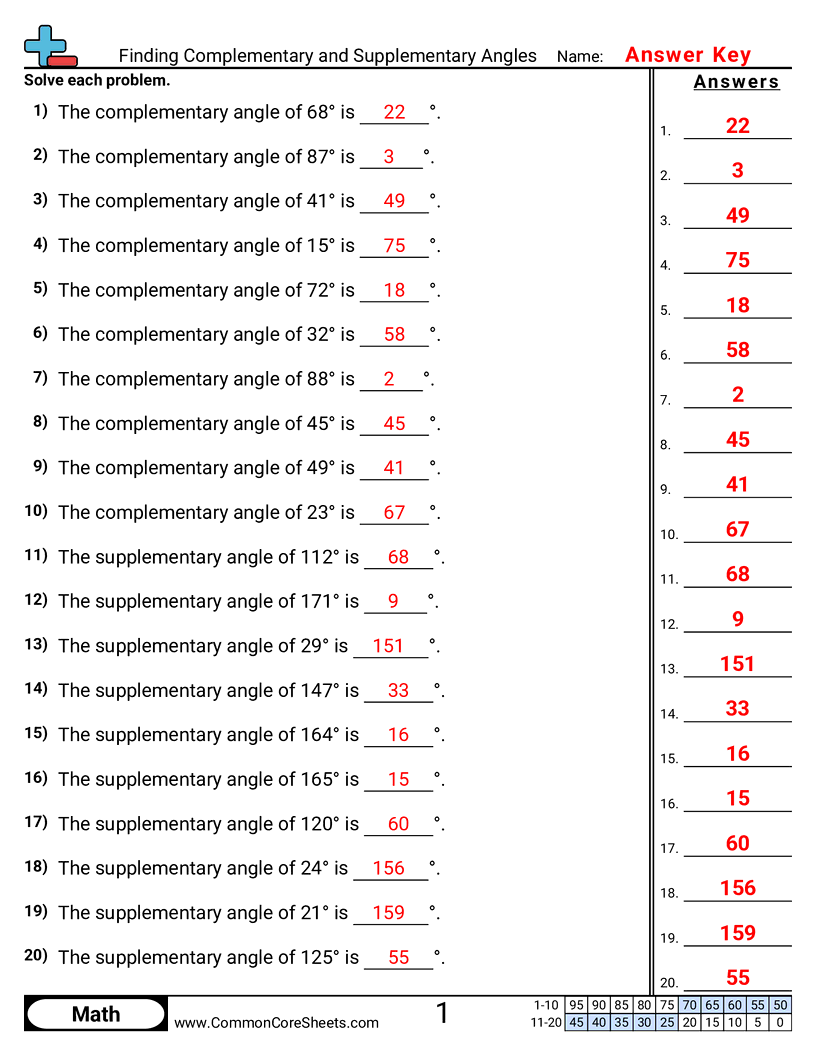
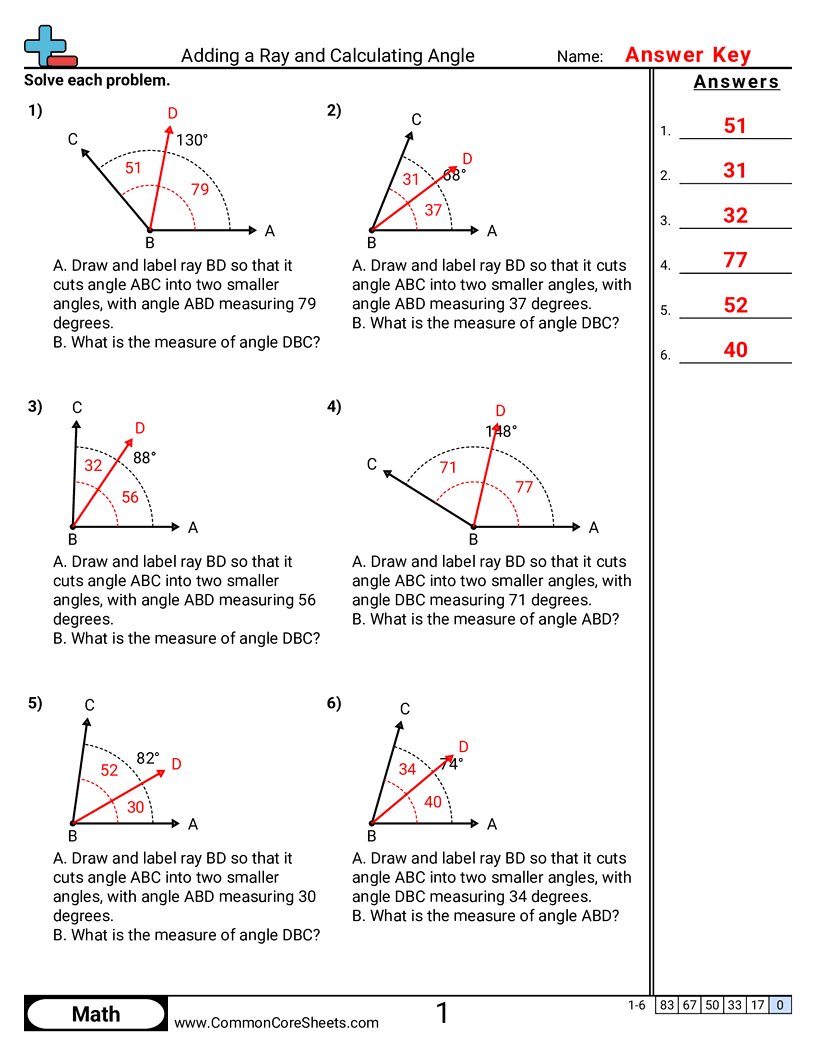
These short sentence angles worksheets provide concise, focused practice with angle concepts. Students work through problems involving angle estimation, finding complementary and supplementary angles, and using protractors to draw rays and calculate angles. The brief format helps students concentrate on key skills without overwhelming text.
Students develop angle measurement and classification skills through a variety of hands-on activities. Worksheets cover using protractors to measure and create angles, identifying acute, obtuse, right, and reflex angles, finding missing angles in shapes and straight lines, and working with complementary and supplementary angle pairs. Topics also include estimating angles, finding angles in circles, and solving for variables in angle equations. These resources span fourth through seventh grade standards.
These worksheets focus on precise angle measurement skills. Students practice finding the angle between two points relative to the origin on a coordinate grid and using a protractor to draw a ray and calculate a missing angle. These activities reinforce protractor use and the concept that adjacent angles combine to form a larger angle.